Photosytem 1 the Electrons Cycle Through This System and Are Used Over Again
The difference betwixt photosystem I and photosystem II is primarily due to the difference in active reaction centre and photon absorption. P700 is the active reaction centre of PS-I, while P680 is the active reaction centre of PS-II. PS-I absorbs calorie-free of a longer wavelength (between 725-1035 nm), while PS-Ii absorbs light of a shorter wavelength (<680 nm).
Photosystem I (PS-I) and photosystem 2 (PS-II) are two multi-subunit complexes that play a pivotal part in the light-dependent reaction of photosynthesis. Chlorophylls are the light-harvesting pigments that found the photosystem and pigment system.
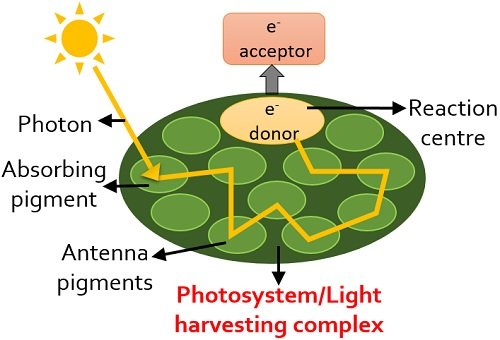
A photosystem possesses an antenna complex (200-300 light-harvesting pigment molecules) and a reaction centre. Based on chlorophyll's different assimilation wavelength, two photosystems (PS I and 2) generally exist. The auxiliary accessory pigments trap photons and manus them over to the specialized protein pigments of the reaction centre.
Content: Photosystem I Vs Photosystem II
- Comparing Chart
- Definition
- Fundamental Differences
- Similarities
- Conclusion
Comparing Chart
| Backdrop | Photosystem I | Photosystem Ii |
|---|---|---|
| Pregnant | PS-I is the photo centre that absorbs photons by the clan of light harvesting pigments, reaction centre (P700) and other accompaniment pigments to produce NADPH | PS-Ii is the photo heart that absorbs photons by the association of light harvesting pigments, reaction centre (P680) and other accessory pigments to produce ATP and oxygen via photolysis of water |
| Location | Found in the outer surface of the thylakoid membrane | Institute in the inner surface of the thylakoid membrane |
| Reaction centre | P700 is an active reaction heart | P680 is an active reaction eye |
| Photon absorption | The light harvesting pigments of photosystem i absorb photons having wavelengths of 700 nm (P700) | The light harvesting pigments of photosystem2 absorb photons having wavelengths of 680 nm (P680) |
| Involvement in photophosphorylation | It is involved in cyclic too every bit non-cyclic photophosphorylation | It is merely involved in not-cyclic photophosphorylation |
| Photolysis of water | PS-I do not carry out photolysis of water | PS-II results in the photolysis of h2o |
| Subunits | Information technology comprises psaA and psaB subunits | It comprises D1 and D2 subunits |
| Protein pigments | Photosystem I includes chlorophyll A-670, chlorophyll A-680, chlorophyll A-695, chlorophyll A-700, chlorophyll B, and carotenoids as the photo pigments | Photosystem Ii includes chlorophyll A-660, chlorophyll A-670, chlorophyll A-680, chlorophyll A-695, chlorophyll A-700, chlorophyll B, xanthophylls and phycobilins as the photo pigments |
| Chlorophyll to carotenoid ratio | xx-30 :1 | three-seven :1 |
| Oxygen production | Does non occur | Oxygen production occurs |
| NADPH product | NADPH production occurs | Does not occur |
| Blazon of reaction centre | PS-I possesses iron sulphur or blazon-I RC | PS-II possesses Q (Quinone) blazon or blazon-II RC |
| Function | It primarily produces NADPH | It primarily produces ATP and causes water hydrolysis |
Definition of Photosystem I
PS I refers to a photosystem that participates in a light reaction of photosynthesis. In dissimilarity to PS Ii, PS I carries more than chlorophyll-a content compared to chlorophyll b. Furthermore, PS I participates in cyclic phosphorylation and produces NADPH. Photosystem I has a reaction centre that possesses chlorophyll-a molecules. Information technology is capable of absorbing low-cal at a wavelength of 700 nm.
The lite-harvesting or antenna complex of PS I absorbs photons and hand them over to its reaction centre containing chlorophyll-a. The reaction centre excites and releases high energy electrons. The high energy molecules enter the electron transport chain through electron carriers and release NADPH.
Definition of Photosystem Two
PS Ii refers to a lite-dependent photosystem that participates in the photosynthetic light reactions. Reverse to PS I, information technology contains more chlorophyll b pigments compared with chlorophyll a. The PS II reaction heart contains chlorophyll-a that has an absorption peak of 680 nm (P680). Furthermore, the pigment molecules of PS Ii blot photons and funnel them to the reaction centre or antenna complex.
The PS II reaction eye excites and releases high energy molecules. Consequently, the primary electron acceptor molecules pick loftier energy electrons and manus them over to the PS I through many carrier molecules. The excitation of electrons through electron carriers of low energy levels releases energy that the cells harness to synthesize ATP from ADP via photophosphorylation.
Central Differences Between Photosystem I and Photosystem 2
- The light-harvesting pigments of photosystems I and II blot photons with wavelengths of 700 nm (P700) and 680 nm (P680), respectively.
- PS-I resides in the thylakoid'due south outer membrane of the chloroplast, i.eastward. non-appressed region. Conversely, PS-Two is present inwards the thylakoid membrane, i.due east. appressed region.
- A photosystem possesses 2 typical classes of reaction centres (blazon I and Ii RCs) responsible for photochemical reactions. PS-I has blazon-I RC or P-700, whereas PS-Ii has blazon-II RC or P-680.
- Photosystem I shows interest in cyclic and non-cyclic photophosphorylation, while photosystem 2 just participates in non-circadian photophosphorylation. The difference between cyclic and noncyclic photophosphorylation is due to the different mechanisms of ATP synthesis.
- PS-I comprises psaA and psaB subunits and possesses iron sulphur or type-I RC, whereas PS-II includes D1 and D2 subunits and possesses Q (Quinone) or type-II reaction RC.
Similarities
- Both PS I and PS Two are light-dependent photosystems that participate in the light reactions of photosynthesis.
- The light-harvesting pigments and the reaction heart (collectively called antenna complex) are 2 common elements in both the photosystems.
- Furthermore, photosystem I and II comprises light-harvesting pigments for photon assimilation and an active reaction centre to excite electrons.
- The location of PS-I and PS-Ii is somewhat common in that they are found in the thylakoid membrane.
Conclusion
Therefore, nosotros tin conclude that photosystems I and II play a fundamental role in trapping photons of selective wavelength and channelizing them to the active reaction center. Institute cells harness the low-cal energy harnessed to generate chemic potential energy similar ATP and NADPH that is again used by the institute cells to synthesize glucose during the dark reaction of photosynthesis.
Source: https://biologyreader.com/difference-between-photosystem-i-and-photosystem-ii.html
0 Response to "Photosytem 1 the Electrons Cycle Through This System and Are Used Over Again"
Postar um comentário